
A Two-Vote Margin and Three Disputed Ballots: Inside a Westworth Village Election Contest
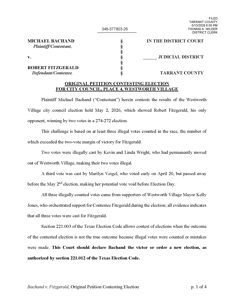
Norred Law is honored to represent Michael Bachand in his election contest for a seat on the city council of Westworth Village, a small Fort Worth-area municipality, which ended with a two-vote margin and three disputed votes. We're seeking a new election on Bachand's behalf.
In the May 2, 2026 race for Place 4 of the City Council, Robert Fitzgerald shows to have won the seat with a vote of 274-272. However, two of those votes were illegally cast by non-residents, and one was cast by a person who passed away before the election, so her vote cannot count. (Obviously, we do not allege that this person did anything wrong; the issue is that early votes are only counted for those who are eligible to vote on election day.)
The Wright Votes
The heart of the legal case involves Kevin and Linda Wright, a couple who permanently relocated from Westworth Village long before the election. Tarrant County records show that the Wrights sold their home in Westworth Village in October 2025, which the Wrights also announce on Facebook, along with their search for a short-term rental in the Mansfield area, departing Westworth Village in October 2025, and planning an eventual permanent move to a ranch being built in East Texas.
The voting records for the city election show that both the Wrights voted from their previous Westworth Village home, along with and the couple who purchased the house.
Under Texas Election Code Section 63.0011, the Wrights were no longer eligible to vote in a Westworth Village municipal election because they no longer resided within the city. Election Advisory 2025-16, issued by the Secretary of State's office, makes clear that a voter who has moved outside a city's boundaries cannot cast a ballot in that city's election, even if their voter registration still lists the old address.
The Mayor's Role
During the election, Jones actively supported Fitzgerald's campaign and worked to mobilize voters on his behalf. It appears that Mayor Jones sits on the board of a company run by KC Wright, and that the two have a documented social friendship, which explains why Jones may have encouraged the Wrights to cast ballots for Fitzgerald despite having moved away from the city.
The Veigel Vote
The third disputed ballot belongs to Marilyn Veigel, who cast an early vote on April 20, 2026, and passed away three days later on April 23 — nine days before Election Day. Under Texas Election Code Section 87.0431, and supported by the 1962 case Mitchell v. Jones, a ballot cast by a voter who dies before election day is considered void. Bachand includes Facebook posts and a class reunion group announcement confirming her death. He also notes that Veigel was politically aligned with Mayor Jones.
A Lopsided Absentee Race
Before getting to the disputed votes, the canvas results reveal a striking pattern: Fitzgerald received 20 absentee votes; Bachand received only 2. In a 546-vote election decided by two votes, that 18-vote absentee advantage was decisive. This lawsuit doesn't challenge those absentee ballots, but the disparity suggests someone was working hard to turn out votes for Fitzgerald well before Election Day. Incumbents often have advantages in these tactics, but 20 to 2 is substantial and was 10x the margin of victory for Fitzgerald. If nothing else, it should give everyone pause about the validity of the absentee ballot process. It won't take much to determine where these votes came from.
The Lawsuit Seeks Victory or a New Election
Under Texas Election Code Section 221.003, courts have authority to review whether illegal votes changed an election's outcome. Bachand is asking the court either to declare him the winner outright — since removing three votes from Fitzgerald's total would flip the two-vote margin — or to void the election entirely and order Westworth Village to hold a new one at the city's expense.
The case is a reminder that in small municipal elections, every single vote genuinely matters, and that voter eligibility rules can become decisive when margins are measured in single digits.
View The Bachand Petition: Here
View The Fitzgerald Answer: Here