
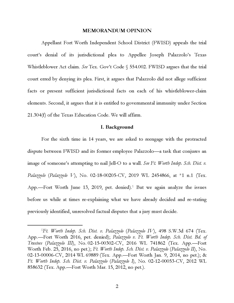
For the sixth time in fourteen years, the Fort Worth Independent School District (FWISD) has asked an appellate court to shut down former assistant principal Joseph Palazzolo's Whistleblower Case — and again, the Appeals Court has said "No."
In its August 13, 2026, opinion, the Second Court of Appeals didn't mince words about the pattern, comparing FWISD's latest effort to "attempting to nail Jell-O to a wall." The case now returns to the trial court, where a jury will finally get the chance to decide whether FWISD retaliated against Palazzolo for reporting misconduct at Arlington Heights High School.
What the Palazzolo Whistleblower Case, a 14-Year fight for accountability, means for Texas public employees:
For Texas public employees who report wrongdoing at their agencies, this case is useful as it demonstrates just how far a governmental employer can go to delay accountability, and why the Texas Whistleblower Act exists in the first place.
Palazzolo served as an assistant principal and campus diversity representative at Arlington Heights High School. In 2010, he reported what he believed were serious violations of law: falsified attendance records, inappropriate conduct by staff, misuse of booster club funds, and discriminatory discipline of minority students. He made those reports to the Texas Education Agency, the Texas State Auditor's Office, and the Tarrant County Criminal District Attorney's Office.
FWISD placed him on administrative leave within weeks and moved to terminate him in 2012. Palazzolo sued under the Texas Whistleblower Act, and a jury sided with him in 2014, awarding him more than $2.4 million. But that verdict was never paid out. An appellate court found a technical error in how the jury was instructed and ordered a new trial. Since then, FWISD has spent the years since fighting to avoid ever letting a jury hear the case again, rather than retrying it or paying what a jury already found he was owed.
The Court's Sixth Rebuke:
This is now the sixth appeal the Second Court of Appeals has had to resolve in this same dispute. Most recently, FWISD filed a plea to the jurisdiction on the eve of a February 2026 trial date, arguing that Palazzolo's pleadings were too vague and that he had no evidence to support his claim. The trial court rejected the plea. FWISD appealed that denial, too.
The court of appeals affirmed the denial across the board, finding that:
Palazzolo's pleadings were sufficient. The court noted that FWISD waited more than 12 years after Palazzolo's petition was filed — and after a full jury trial on that very petition — to argue it was too vague, calling the delay "an extreme delay measure."
Palazzolo presented more than enough evidence. Sworn testimony in the record, including from a former FWISD trustee who called the district's conduct "obvious[ly]" retaliatory and part of a "systematic plan," was enough to send the case to a jury.
FWISD's immunity argument didn't hold up. FWISD claimed that paying Palazzolo a year's salary under a Texas Education Code provision, instead of reinstating him, somehow restored its governmental immunity from suit. The court rejected that theory, reiterating its earlier warning that a school board cannot "buy off" a whistleblower claim for the price of a year's salary.
What This Means for Whistleblowers and Taxpayers:
The Texas Whistleblower Act exists to protect public employees who report government wrongdoings and to give them a real path to hold their employer accountable when they're punished for it. Cases like this one show why that protection sometimes must be fought for repeatedly. Every appeal costs the district money that could go to classrooms, and it delays justice for an employee who did exactly what the law asks public employees to do.
This litigation is also unfolding against the backdrop of the Texas Education Agency's late-2025 determination that FWISD's performance warranted state intervention. For Fort Worth taxpayers and district families watching that process, the district's handling of this long-running case is part of the same larger picture.
The obvious and ongoing question that looms large:
Do the members of the appointed FWISD Board of Managers even know that this case exists, or is its counsel running amuck, with the apparent blessing of a low-level bureaucrat in the FWISD governing structure that is dedicated to keeping the case alive, rather than doing right?
This case has not been listed on the agenda for consideration since the Board was installed. The excuse given to the Court of Appeals when queried about the matter was that an inside counsel attorney with minimal experience is acting as the liaison, and the Board need not worry its little heads about the issue. Predictable, but unacceptable. Or at least, we'll see...maybe.
You can read the opinion HERE.